


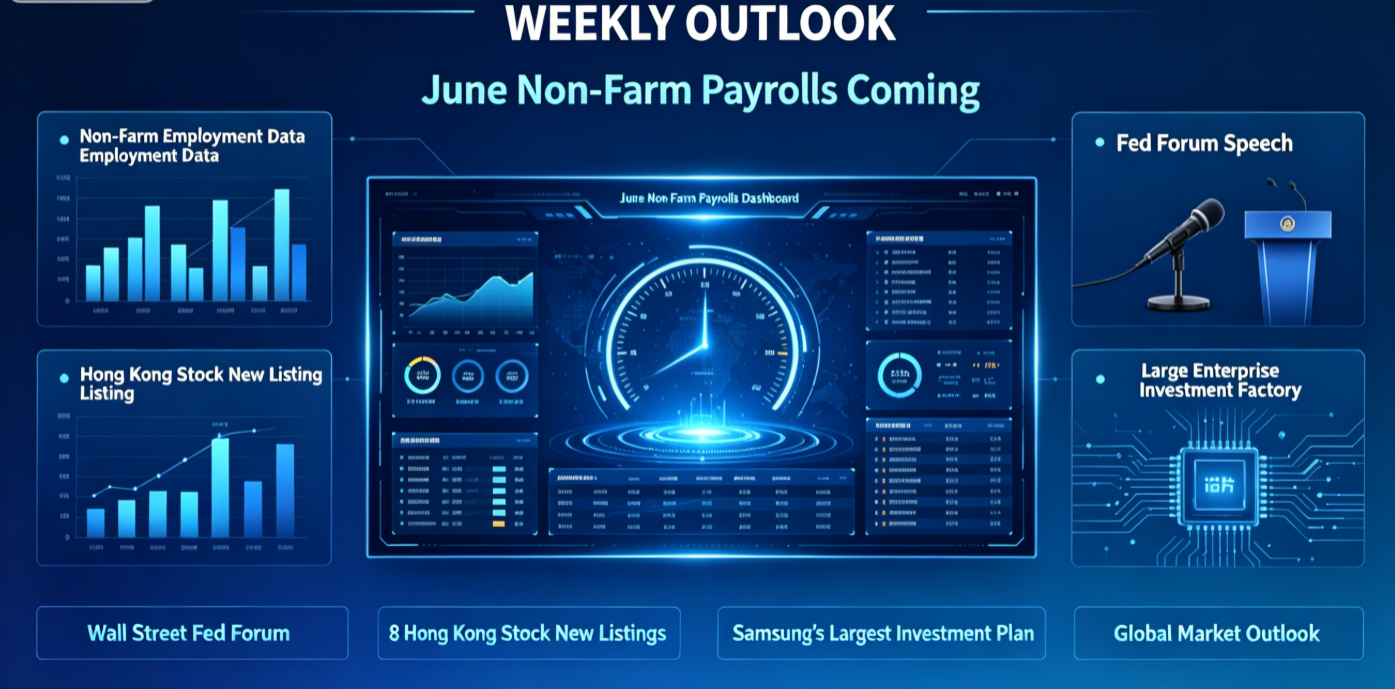
This week, global financial markets enter a Super Week, with dense releases: U.S. June nonfarm payrolls, Fed policy stance, ECB forum, Middle East situation, and chip price hikes.
Market Focus: In-depth Analysis of Key Events in the New Week
Keywords: Nonfarm Payrolls, Fed, ECB Forum, Middle East Situation, Chip Price Hikes, Manufacturing PMI
As the past trading week draws to a close, global financial markets are about to face a series of key events and data releases that will profoundly impact asset pricing and policy expectations for the second half of the year. From the early release of the U.S. June nonfarm payrolls report, to the joint appearances of multiple central bank governors at the European Central Bank's annual policy forum, to the convergence of geopolitical risks and industrial chain price hikes, this week (June 29 to July 4) can be called a “Super Week.” This article provides an in-depth analysis of core issues to offer professional insights for investors.
1. U.S. Labor Market Test: Can Nonfarm Data Shift the Fed's Stance?
The most anticipated economic data this week is undoubtedly the early release of the U.S. June nonfarm payrolls report and unemployment rate on Thursday, July 2. According to market consensus, June is expected to add 113,000 jobs, with the unemployment rate rising to 4.3%. This data backdrop deserves close attention: the three-month moving average of nonfarm payrolls has climbed to 188,000, a new high since the first quarter of 2024, indicating strong resilience in the labor market.
However, the core market contradiction is whether current job growth is sufficient to alter the Fed's tightening stance. Based on the June FOMC minutes and the hawkish signals recently released by Chair Woshi, most policymakers believe the labor market is healthy and not significantly driving inflation. Unless the series of employment data released this week (including Wednesday's ADP employment report and Thursday's nonfarm data) collectively show a “cliff-like downward revision” well below expectations, it is unlikely to shake the Fed's resolve to tighten.
Investec economic analysts pointed out in a research report that U.S. economic data is a key barometer for policy direction. Recent indicators have shown signs of stabilization, and this month's data is expected to further confirm this trend, with an estimated job gain of around 160,000, not far from May's 172,000. If actual data is strong, it will further reinforce market expectations of continued Fed rate hikes, potentially supporting the dollar and U.S. Treasury yields.
2. Global Central Bank Forum: Woshi's Speech Becomes Focus
The European Central Bank's Annual Policy Forum will be held in Sintra, Portugal from June 29 to July 1. This forum brings together major central bank leaders, including ECB President Lagarde, Bank of England Governor Bailey, and Fed Chair Woshi. The market is particularly focused on how the Middle East situation will affect the monetary policy environment. Given the uncertainty surrounding the transmission of the initial energy price shock, central banks are likely to maintain a cautious stance in the short term.
Among them, the most anticipated event is Fed Chair Woshi's speech on the evening of July 1. If he continues his recent hawkish tone at the forum, it will directly strengthen market expectations of Fed rate hikes. Meanwhile, ECB President Lagarde's interpretation of European economic growth and financial stability will also provide important clues about the European tightening path.
3. Geopolitical Risks and Oil Price Game: U.S.-Iran Tensions Escalate Again
In the Middle East, tensions between the United States and Iran have escalated again. On the 28th local time, Iran's Foreign Ministry issued a statement strongly condemning U.S. attacks on multiple locations along its southern coast, calling it a flagrant violation of the UN Charter and the memorandum of understanding previously signed by both sides. Iran called on the UN Security Council to maintain international peace and security and emphasized its determination to defend national sovereignty.
The new conflict in the Persian Gulf shows that even if the two sides had previously reached a provisional agreement to push for a final ceasefire, the risk of war with Iran could still spiral out of control. This situation has directly raised the alarm for an oil price rebound. Whether the second round of energy price shocks will create new upside pressure on global inflation, thereby forcing central banks to maintain or even strengthen tightening, is a core issue that the market will need to closely monitor this week.
4. Asian Markets and Industry Dynamics: China PMI and Chip Price Hikes
On the Asian market front, China's official manufacturing PMI for June will be released on June 30. The May figure stood at 50.0, down 0.3 percentage points from the previous month, at the breakeven point. The market expects a slight rebound in June; if the actual reading is higher than expected, it will help boost confidence in the economic recovery.
At the same time, a global industrial chain price hike driven by AI demand is accelerating. As of July, more than ten leading semiconductor and related companies have announced product price increases. Murata raised prices for AI server and automotive-grade MLCCs by 10%-40%, Nippon Sanso increased ammonia prices by more than 30%, and MediaTek, Infineon, Texas Instruments, and others have followed suit. This wave of price hikes has covered almost all IC design companies in the Taiwan region. Whether it can be smoothly transmitted to end consumption and whether it will suppress demand will be the focus of market attention.
Additionally, Samsung Group will announce on June 29 a ten-year investment plan totaling 1,000 trillion won (approximately 4 trillion yuan) for domestic South Korea, the largest investment in the history of a Korean company. This move aims to maintain technological leadership and support the government's balanced regional development.
5. Other Key Events at a Glance
- Davos Tech Summit: Held in Davos, Switzerland from July 1 to 4, focusing on the theme of “Physical AI and Robotics.”
- Hong Kong Stock Market Holiday and New Listings: July 1, Hong Kong Special Administrative Region Establishment Day, Hong Kong stock market closed. Several new stocks will debut on the Hong Kong Stock Exchange this week, including Libang Pharmaceuticals and Haiguang Xinzheng.
- China Services PMI: On July 3, the June RatingDog Services PMI for China will be released, reflecting the health of the services sector.
- U.S. Stock Market Closed: July 3, U.S. Independence Day, U.S. stock market closed.
Conclusion
Overall, global markets will face multiple tests this week from U.S. employment data, central bank policy signals, geopolitical risks, and industry price hikes. Whether nonfarm data can change Fed policy expectations, whether the Middle East situation will further push up oil prices, and how hip price hikes will affect inflation and tech stock valuations, are the core variables that will determine the market direction this week. Investors should remain highly vigilant and respond flexibly to various possibilities.
本网站上的所有信息、报价、分析和研究报告仅供参考,不构成任何投资建议、交易推荐或金融招揽。市场存在风险,请谨慎投资。

