


Silver Plunge Triggers Sharp Turbulence in Precious Metals
A sharp intraday plunge in international silver jolted the precious-metals market, with gold also pulling back and A-share precious-metals stocks and related funds swinging violently. This article examines the sudden drop in silver prices, changes in the gold-silver ratio, overbought risks, and capital battles, while also tracking how solar demand may affect silver's trend.
Silver Plunge Sends the Precious-Metals Market Into Turmoil: Valuation Reset and Capital Battles in the Era of High Volatility
Keywords: silver plunge, gold price, precious-metals sector, A-shares, overbought, gold-silver ratio, solar demand
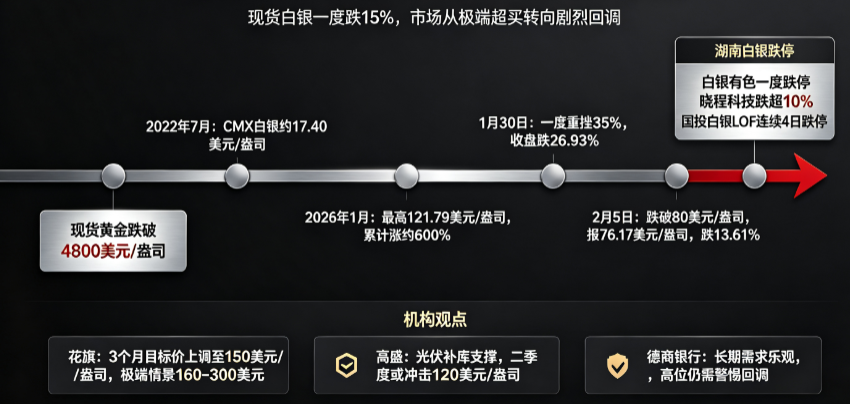
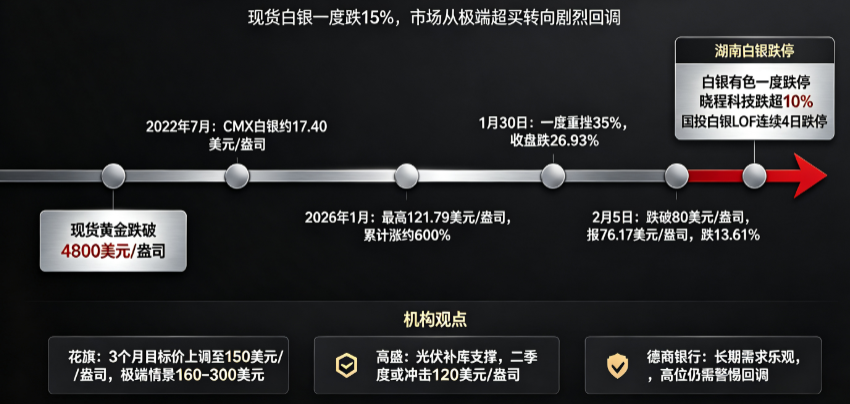
On February 5, the global precious-metals market once again saw extreme swings. Spot silver once fell as much as 15% intraday, breaking below the $80/oz mark, while spot gold also lost the $4,800/oz level. For silver, this was not an ordinary pullback, but a rapid unwinding of excess froth triggered jointly by sentiment, valuation, and capital structure. The huge gains accumulated earlier in the precious-metals market were released in a concentrated burst over a short period, sharply amplifying price volatility.
1. Silver's sharp drop hits the precious-metals sector first
The violent slide in international silver prices quickly spread to the A-share market, where the precious-metals sector saw broad intraday corrections. Hunan Silver locked at the daily limit down, Silver Nonferrous briefly hit limit down, and Xiaocheng Technology fell more than 10%; meanwhile, the much-watched "viral fund" SDIC Silver LOF resumed trading and again hit limit down, marking the fourth straight trading day at limit down.
This is not surprising. The A-share precious-metals sector is highly correlated with international gold and silver prices, so when overseas markets experience extreme swings, related stocks and funds often react first. More importantly, the sector had already posted huge gains, while valuation and trading crowding both rose. Once international prices turn, concentrated profit-taking can magnify equity elasticity, making the decline far faster than the rise.
2. Why silver is more "fragile" than gold
Although silver and gold are both precious metals, their pricing logic is not exactly the same. Gold is more financial and safe-haven in nature, while more than half of silver demand comes from industry, especially the solar, electronics, solder, and new-energy supply chains. This means silver prices are influenced both by macro liquidity and by real-demand cycles, making volatility naturally higher than gold.
The current silver rally began in July 2022, when the CMX front-month silver contract once touched a cyclical low of $17.40/oz, then embarked on a three-and-a-half-year uptrend, rising to a peak of $121.79/oz in January 2026, for a cumulative gain of about 600%. Such a surge itself means the market is in a highly sensitive state: as soon as a marginal negative appears, prices can easily slip into "imbalance at high levels."
More importantly, major international banks have clearly warned that multiple technical indicators for both gold and silver have entered severely overbought territory. Gold RSI once surged above 90, far beyond the usual overbought warning line; silver RSI also rose above 80, showing that market sentiment was extremely overheated. For assets like these, overheated technicals are often not the whole reason a trend ends, but they are frequently the direct catalyst for a sharp sell-off.
3. Behind the extreme turbulence lies a resonance of sentiment and leverage
On January 30, the global precious-metals market had already experienced another round of extreme turbulence: spot silver once plunged as much as 35% intraday to $73/oz, the largest single-day drop on record, and still ended down 26.93% at $84.63/oz. The weekly decline exceeded 17%, while all Shanghai silver futures contracts hit limit down, with the main contract falling 17%. This shows that the market was not simply undergoing a normal correction, but had entered a vulnerable phase shaped by the combined effects of high leverage, crowded positioning, and highly consistent expectations.
When an uptrend lasts too long, market participants often develop an inertia of "buying every dip"; but when prices have already detached from fundamental constraints, that consensus can instead magnify risk at the turning point. Once an external catalyst appears, such as dollar volatility, changes in interest-rate expectations, futures position unwinding, or the withdrawal of arbitrage capital, selling pressure can be triggered rapidly and create a chain reaction.
4. Institutions still remain constructive on the medium- to long-term outlook, but short-term divergence is widening
Despite the severe short-term volatility, mainstream financial institutions remain relatively optimistic on silver's medium- to long-term trend, though differences are clearly widening. Citi has taken the most aggressive stance, sharply lifting its 3-month silver target to $150/oz, arguing that the current silver move is like "gold squared" or a "turbocharged version of gold"; if the gold-silver ratio returns to historical highs, silver could even test the extreme range of $160 to $300.
Goldman Sachs puts more emphasis on industrial logic, believing silver may benefit from the solar restocking cycle and expecting prices to challenge $120/oz in the second quarter. However, Goldman also warns that silver does not have central-bank reserve demand as an underlying source of support, making it more sensitive to capital flows, with significantly higher volatility and uncertainty than gold. Commerzbank, meanwhile, believes spot silver is at historical highs, short-term pullback risk cannot be ignored, but the long-term demand outlook remains upbeat.
These views point to one reality: silver's long-term narrative has not been disproved, but its short-term trading logic has shifted from "trend chasing" to "high-level positioning battles." In other words, the market is not bearish on silver; rather, the way it is priced is changing.
5. From an investment perspective, the risk boundary matters more
For silver and precious-metals-related assets, the most important question now is not whether prices can still rise, but how large the volatility may be. After a historic rally, any negative news can be amplified; against the backdrop of severely overbought technical indicators and highly aligned sentiment, price pullbacks often have more downside power than expected.
For ordinary investors, it is even more important to distinguish the risk characteristics of gold and silver: gold is more suitable for stable allocation, while silver is better suited to high-beta trading; gold is more appropriate for long-term asset allocation, while silver depends more on timing, position sizing, and risk control. Chasing the rally blindly at high levels not only exposes investors to price-reversal risk, but may also face a second удар from rapidly shrinking liquidity.
Conclusion
The silver crash does not mean the precious-metals bull market is over; rather, it signals that the market has entered a more complex phase: the earlier rise driven jointly by liquidity, safe-haven demand, and industrial expectations has evolved into high-level valuation reset and capital rebalancing. In the short term, the precious-metals market will likely remain highly volatile; in the medium to long term, silver's industrial role, solar demand, and the logic of gold-silver ratio normalization still leave room for imagination.
But in an environment where trend and risk coexist, what truly determines returns is no longer just the directional call, but the ability to manage pace, position size, and volatility.

All information, quotes, analysis, and research reports on this website are for reference only and do not constitute any investment advice, trading recommendations, or financial solicitation. Market risk exists, invest with caution.