


Gold Stocks Rebound: Price Recovery & Institutional Divergence
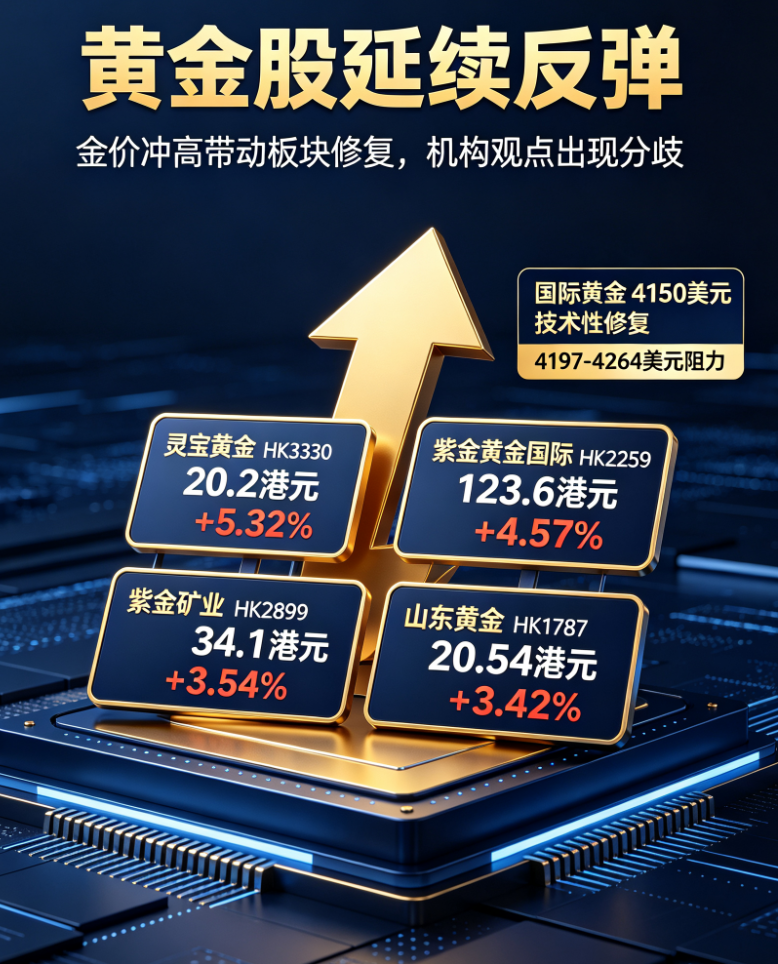
Recent HK gold stocks rebounded as gold price topped $4150/oz. HSBC, JPMorgan, Huachuang diverged: HSBC sees gradual strength, JPMorgan technical repair, Huachuang allocation value. This article analyzes price drivers, institutional comparison, sector value, and medium-long term logic.
Logic Behind Gold Stocks Rebound: Price Recovery & Institutional Divergence
Keywords: Gold stocks; Gold price rebound; Institutional views; Investment strategy; Macro economy
Introduction
Recently, HK gold stocks extended rebound, with Lingbao Gold (03330.HK) up 5.32% to HKD 20.2, Zijin Gold International (02259.HK) up 4.57% to HKD 123.6, Zijin Mining (02899.HK) up 3.54% to HKD 34.1, Shandong Gold (01787.HK) up 3.42% to HKD 20.54. Behind this rise, international gold price reclaimed $4150/oz, hitting a two-week high. However, institutions diverge on the rebound's nature: HSBC expects gradual rise but geopolitical risk as key downside; JPMorgan notes medium-term bearish pattern unchanged, current rise looks like technical repair; Huachuang Securities emphasizes bottom allocation value given easing macro constraints. Against weakening macro data and cooling rate hike expectations, gold market faces a complex but worth-pondering window. This article analyzes from four dimensions: price drivers, institutional comparison, sector value, and medium-long term logic, to present a complete market picture.
I. Gold Price Breaks $4150: Start of Repair Window
As of press time, international gold price briefly stood above $4150/oz, a two-week high. The rebound is driven by multiple factors. First, weaker US June inflation and employment data directly cooled market expectations for Fed rate hikes. CME FedWatch shows September pause probability rose from below 30% to near 50%. Lower rate expectations eased pressure on gold as a non-yielding asset, providing the catalyst. Second, central banks' persistent gold buying trend remains. World Gold Council data shows global net purchases stayed at record highs in H1, with China, Poland, Singapore adding. De-dollarization logic deepened after Russia-Ukraine conflict and SWIFT sanctions, solidifying gold's reserve asset status. Third, geopolitical risks continue to underpin. Middle East tensions, US-China rivalry, European energy transition pains keep safe-haven demand high. Even without rate reversal, gold's haven attribute provides solid floor support.
(The chart shows gold's daily trend since June 2025, with yellow arrows marking $4150 breakout and $4500 medium-term resistance. Current price is still in a correction channel since 2024 highs, but MACD shows bottom golden cross, implying short-term bullish momentum.)
II. Institutional Divergence: Trend Reversal or Technical Repair?
Leading institutions differ on the same rebound, reflecting the market's complexity. HSBC is relatively positive, seeing market fully pricing in Fed tightening expectations. As real rates peak, gold may gradually rise. But geopolitical events sparking oil spikes could cause second inflation risks, forcing Fed to stay hawkish, a major downside. In short, HSBC favors a "mild recovery" path, not a bull run. JPMorgan (JPM) is more cautious. Its technical analysis team says $4197-4264 resistance has not been broken, medium-term bearish pattern remains. Current rise looks like oversold technical repair, not trend reversal. JPM sets medium-term resistance near $4500; if not held, gold may retest prior lows. Huachuang Securities gives a clear bullish signal from fundamental valuation. The sector benefits from easing macro constraints, making bottom allocation attractive. Gold adjusted under US bond yields in H1, but weaker June inflation and employment have cooled rate expectations, opening a repair window. Medium-long term, inflation may trend down, while central bank buying and de-dollarization logic remains intact, with geopolitical risks supporting prices. Huachuang unites short-term trading with long-term allocation, providing a logical closed loop.
III. Gold Stock Gains: Valuation Recovery & Earnings Expectations
In terms of individual stocks, Lingbao Gold and Zijin Gold International led gains, followed by Zijin Mining and Shandong Gold. Their outperformance relates to business structure, cost control, and gold price elasticity. Lingbao Gold, a medium-sized gold mining and smelting firm, has high stock price elasticity to gold volatility. Its current P/E remains at three-year lows; if gold holds above $4000, profitability may improve significantly. Zijin Gold International leverages Zijin Mining Group's global resource layout, with copper-gold dual drive offering stronger risk resistance and growth. Shandong Gold, as domestic leader, is noted for governance optimization and overseas mine output. Technically, the gold sector index, after half-year adjustment, nears 2024 lows. Volume is expanding moderately, KDJ forms golden cross, short-term rebound momentum adequate. But sector valuation remains affected by rate levels and gold expectations; only if gold breaks through effectively can stocks open upside space.
(The chart shows July 24 intraday gains of major gold stocks and 30-day RSI. Lingbao Gold and Zijin Gold International have RSI near 60, short-term elasticity above sector average; Zijin Mining and Shandong Gold have RSI near 50, showing more accumulation.)
IV. Medium-Long Term Logic: Central Bank Buying & De-dollarization Narrative
Although short-term gold prices are significantly affected by rate expectations, from a medium-long term perspective, gold's fundamental drivers are changing profoundly. On one hand, global central banks' gold buying has shifted from "emergency reserve" to "strategic allocation." Since 2022, annual net purchases of kiloton levels have altered gold's demand structure. Emerging economies are accelerating reduction of dollar dependency, using gold as a core tool for forex reserve diversification. This structural change will continuously lift gold's floor. On the other hand, de-dollarization will not reverse with Fed hawkishness or dovishness. Whether it's BRICS promoting local currency settlement or IMF SDR weight adjustments, they are eroding dollar hegemony. Against this backdrop, gold's role as a "stateless currency" value anchor becomes more prominent. Huachuang's view that "central bank buying, de-dollarization long logic unbroken" captures this precisely. Even if short-term rates still fluctuate, gold's long-term allocation value is recognized by more institutional investors. For ordinary investors, the current gold sector adjustment is precisely a window to gradually build a base position.
Conclusion
Overall, behind this gold stock rebound and price recovery are both cooling rate expectations from weaker macro data and persistent geopolitical risks and central bank buying. However, institutional divergence reminds us that the market has not formed a consensus on a trend reversal — $4197-4264 resistance not broken, and $4500 is key to confirming a medium-term bullish pattern. For investors, focus on: 1) whether subsequent US inflation and employment data continue to weaken, fundamentally altering Fed's path; 2) whether geopolitical surprises, especially oil spike impacts on inflation expectations, emerge; 3) whether gold stocks' valuation recovery is accompanied by earnings realization, not just sentiment. In an uncertain market, only by anchoring long-term logic, respecting technicals, and being wary of risks can one achieve stable returns in gold investment. At present, gold sector's risk-reward is improving, but true trend opportunities may need more time and data confirmation.

All information, quotes, analysis, and research reports on this website are for reference only and do not constitute any investment advice, trading recommendations, or financial solicitation. Market risk exists, invest with caution.