


Behind the Gold and Silver Wild Swings: Bull Market Logic Is Being Rebuilt
Analyzing the deeper reasons behind the sharp swings in international gold and silver, with a focus on central bank gold buying, speculative capital, safe-haven demand, and changes in institutional pricing to explain how the precious metals bull market logic is being rebuilt.
Behind the Gold and Silver “Roller Coaster”: Precious Metals Bull Market Logic Is Being Rebuilt
Keywords: international gold, silver, precious metals market, central bank gold buying, investment portfolio, market volatility, speculative trading, safe-haven assets
Introduction
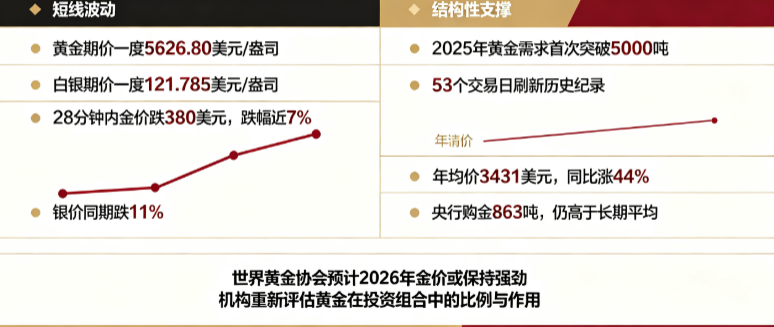
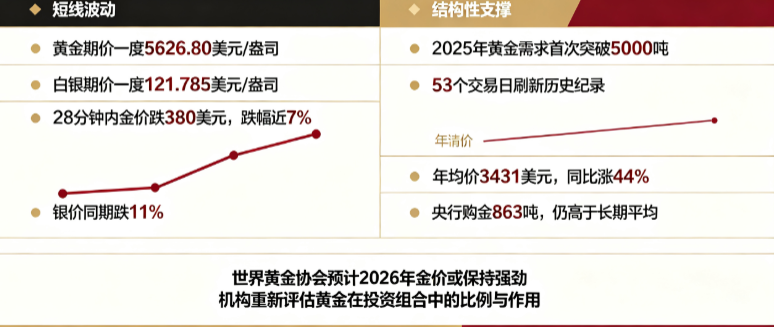
Recently, the international gold and silver markets have staged a highly dramatic “roller coaster” ride: prices surged to rare historical highs and then were hit by a fierce sell-off in an extremely short period, drawing close attention from investors worldwide. According to New York Mercantile Exchange data, April gold futures briefly touched $5,626.80 per ounce in early trading on the 29th, while March silver futures once reached $121.785 per ounce. But the market then suddenly reversed, with gold plunging $380 in just 28 minutes, a drop of nearly 7%, while silver fell 11% over the same period.
On the surface, this looks like a sharp technical correction. But at a deeper level, the volatility reflects changes in market structure, capital behavior, and investment logic in the precious metals market. Behind the sharp rise and fall are not only speculative forces amplifying the move, but also the process of re-pricing gold by central banks, institutional investors, and ordinary traders.
1. Extreme volatility is no accident; speculative capital has amplified market sensitivity
The precious metals market has long combined financial and safe-haven attributes, but once prices enter a rapid uptrend, volatility often expands significantly. Analysts point out that the parabolic rise in international gold and silver prices recently attracted a large number of speculators and algorithmic trading bots into the market. The concentrated inflow of short-term funds made prices unusually sensitive to news, technical levels, and programmed signals.
Kevin Grady, president of Phoenix Futures and Options, believes one important reason for this round of violent swings is the combination of amplified effects from algorithmic trading and the temporary withdrawal of ordinary traders. In other words, when more and more momentum-chasing money floods the market while traditional traders stay on the sidelines, the price structure becomes more fragile. Once profit-taking or stop-loss orders are triggered, selling can quickly turn into a chain reaction, creating an extreme “sudden drop from the top.”
This was especially evident in the silver market. Silver has both industrial metal and financial asset characteristics, with greater price elasticity and a relatively smaller market size. As a result, driven by sentiment, it is more prone than gold to sharp swings. The 11% drop in silver within a short time is a concentrated reflection of this trait.
2. Beyond the price swings, the more important story is structural change
If one only watches price movements, it is easy to miss the deeper transformation taking place in the precious metals market. The World Gold Council recently released its 2025 Q4 and Full-Year Gold Demand Trends Report, noting that gold’s 2025 rally “has consolidated gold’s position in the minds of central banks, investors and consumers,” and that the impact of this structural adjustment is expected to continue into early 2026.
This means gold is no longer merely a temporary safe-haven tool during crises; it is regaining a more stable position in the global asset allocation system. In the past, gold was often seen as a “marginal asset” used to hedge risk. Today, amid high debt, geopolitical tensions, and rising uncertainty in the monetary system, more and more institutions are beginning to view gold as a core stabilizer in their portfolios.
According to the World Gold Council, global physical gold demand in 2025 surpassed 5,000 tonnes for the first time, setting a new record. Gold prices hit new highs within 53 trading days, and the annual average price reached $3,431 per ounce, up 44% year over year. These figures show that gold’s strength is not simply driven by short-term speculation, but is built on real demand expansion.
3. Continued central bank gold buying reflects a re-evaluation of the traditional reserve system
Within gold demand, central bank behavior is especially worth attention. The report shows that although central bank gold buying slowed in 2025 compared with the extraordinary pace of the previous three years, annual purchases still reached 863 tonnes, far above the long-term average. In other words, even if the pace of buying was less aggressive than in recent years, central banks’ allocation demand for gold remained at historically high levels.
Continued central bank accumulation of gold reflects not short-term trading logic, but a long-term assessment of the safety and stability of international reserve assets. High debt levels, persistent geopolitical risks, and declining confidence in traditional reserve assets in some countries are prompting more central banks to reassess the structure of their foreign exchange reserves. Gold carries no credit risk and no sovereign default risk, and in extreme environments it has an independent value that other assets cannot easily replace.
From this perspective, the rise in gold prices is not just a bubble created by “hot money” in the market, but also the result of changes in the global monetary system and asset allocation preferences. Continued central bank buying has built a much firmer underlying support for gold.
4. Institutional investors are repositioning gold, and asset allocation logic is changing
In addition to central banks, institutional investors are also changing their stance toward gold. Market analysts point out that focusing only on price volatility can obscure how institutions are re-evaluating gold’s weight and role in investment portfolios. In the past, gold was more often seen as an “insurance asset” with a limited allocation. In an environment of rising uncertainty, however, it is being redefined as a portfolio stabilizer, a liquidity buffer, and even an important tool for countering macroeconomic imbalances.
This shift is not an abstract judgment; it has already been reflected in the data. The expansion of physical gold demand, record-high gold prices, and central bank purchases remaining at elevated levels all show that market recognition of gold is moving from the emotional level to the institutional level. For long-term capital, gold’s value is no longer just about “profiting from price increases,” but also about its ability to provide lower-correlation hedging when stocks, bonds, commodities, and even currencies become more volatile.
This also means that gold’s valuation logic may change further in the future. Its pricing will no longer rely entirely on short-term speculative forces, but will be determined more by global capital allocation, central bank reserve adjustments, and macro risk premia working together.
5. Silver’s high elasticity may prolong a pattern of both volatility and opportunity
Compared with gold, the silver market may be even harder to calm. Silver is influenced both by safe-haven demand for precious metals and by industrial demand. It shifts between expectations for the economy, manufacturing conditions, and financial speculation, making it more likely to show the pattern of “rising faster and falling quicker.” The sharp simultaneous pullback in silver prices this time shows that after the extreme rally, short-term leverage and sentiment trading are being rapidly washed out.
But in the medium to long term, silver does not simply mean a risk asset. As demand for silver continues in new energy, electronics manufacturing, photovoltaics, and other sectors, its industrial characteristics may also provide some support for prices in the future. However, in the current environment of highly concentrated capital and significantly amplified volatility, the silver market is better viewed through a risk-management lens rather than as a place to chase short-term gains.
Conclusion
Overall, the sharp volatility in international gold and silver is not a signal that the precious metals bull market has ended. Rather, it looks more like a “high-volatility recalibration” after the market has entered a new stage. In the short term, speculative capital, algorithmic trading, and sentiment swings will continue to magnify price fluctuations. But in the medium to long term, record gold demand, continued central bank buying, and institutional asset reallocation are still steadily reinforcing gold’s strategic value.
The World Gold Council expects gold prices may maintain strong momentum in 2026. That judgment is based not only on the current supply-demand structure, but also on the fact that uncertainty in the global economy and financial system has not yet dissipated. It is foreseeable that gold’s role will continue to evolve from a “safe-haven tool” into an “asset portfolio stabilizer,” which also means the volatility of the precious metals market may only now be entering a more complex phase.

All information, quotes, analysis, and research reports on this website are for reference only and do not constitute any investment advice, trading recommendations, or financial solicitation. Market risk exists, invest with caution.