


Global precious metals pull back sharply, risk repricing intensifies
Global precious metals have recently pulled back sharply, with gold and silver falling in tandem and COMEX gold and silver posting clear declines. After a sustained rally and repeated record highs, signs of short-term overheating have emerged, sentiment has cooled, volatility has intensified, and risk repricing has risen.
Global Precious Metals See Sharp Selloff: Risk Repricing Amid High-Level Volatility
Keywords: International gold prices, international silver prices, precious metals market, COMEX, safe-haven assets, price correction, market volatility
Recently, the global precious metals market has undergone a clear correction, with gold and silver prices falling sharply in tandem, drawing wide attention. As of 14:15, London spot gold was at $4,580.63/oz, down more than 3%, with an intraday drop of over 4% at one point; London spot silver was at $70.069/oz, down more than 6%. Meanwhile, COMEX gold and COMEX silver also fell more than 4% and 6%, respectively. After a sustained rally and repeated record highs, this rapid pullback signals a concentrated correction after a period of short-term overheating in the precious metals market.
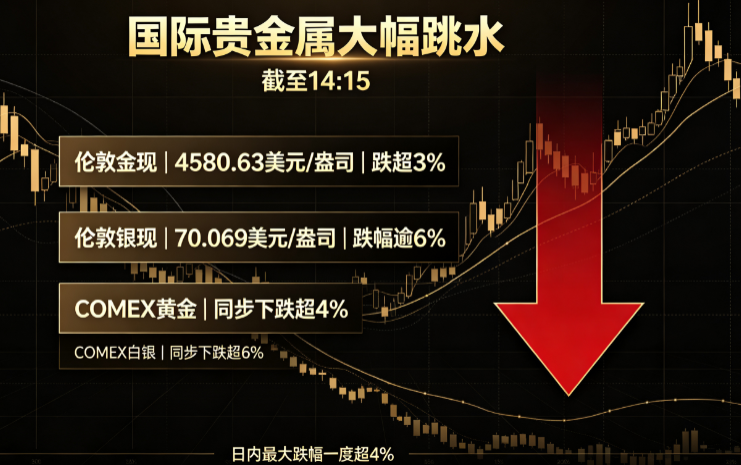
1. Gold and silver correct in tandem, market sentiment cools noticeably
From the price action, both gold and silver posted sizable coordinated declines, suggesting that this correction is not just a technical move in a single asset, but more like a broad cooling of capital flows. Gold, as a traditional safe-haven asset, is often favored when macro uncertainty rises; silver, meanwhile, has both financial and industrial attributes, making it more volatile. As a result, it often leads gains during rallies and amplifies losses during pullbacks.
In this decline, silver fell significantly more than gold, highlighting the more obvious profit-taking at elevated levels. With precious metals prices having strengthened for some time, some investors chased the rally at higher levels, and leverage and sentiment-driven trading had built up. Once prices turned, it was easy to trigger a chain of profit-taking and stop-loss selling, resulting in a faster downward move.
2. The upward logic has not changed, but short-term valuation pressure has increased
The earlier rise in precious metals was still mainly driven by global macro uncertainty, geopolitical risks, fluctuating inflation expectations, and an unclear monetary policy path. As long as these factors have not fully eased, gold still retains long-term allocation value. However, rising prices do not necessarily mean the trend will continue in a straight line, especially after the market has fully priced in positive factors; any marginal change may trigger a rebalancing of valuations.
From a technical perspective, after the rapid surge, gold and silver have accumulated substantial unrealized gains. In the short term, the market is paying more attention to the ability to absorb supply at elevated levels than to the safe-haven narrative alone. When the dollar trend, real rate expectations, or risk appetite shift temporarily, precious metals can easily enter a choppy correction range. This decline reflects both profit-taking and a more cautious stance toward the prior gains.
3. Silver is more volatile, and the risks of its high beta should not be ignored
Compared with gold, silver usually sees sharper price swings. It has a higher share of industrial demand and is more sensitive to manufacturing conditions, solar industry demand, and global growth expectations. Therefore, when macro expectations are unstable, silver often shows the pattern of “rising faster and falling faster.” The more than 6% drop this time suggests that the market’s risk appetite for high-level silver is declining rapidly.
For investors, this means precious metals allocation cannot simply be viewed through a one-size-fits-all “safe-haven asset” lens. Gold is better suited for defensive positioning in long-term asset allocation, while silver is more appropriate for investors with stronger risk tolerance who seek swing trades. Especially when prices are in historically high ranges, position management and volatility risk deserve more attention than blindly chasing higher prices.
Conclusion
Overall, the sharp selloff in global precious metals this round is more a stage of correction after a rapid run-up at high levels than a complete reversal of the underlying trend logic. The long-term support factors for gold and silver remain intact, but the market has now entered a phase of repricing both gains and sentiment in the short term. In the period ahead, whether precious metals can stabilize still depends mainly on changes in macro data, rate expectations, and geopolitical risk. For market participants, the key now is to stay rational and focus on the reality of coexisting trends and volatility, seeking a more resilient balance between risk and return.

All information, quotes, analysis, and research reports on this website are for reference only and do not constitute any investment advice, trading recommendations, or financial solicitation. Market risk exists, invest with caution.