


Gold Market Long-Short: Weak Jewelry Demand vs Investment Demand
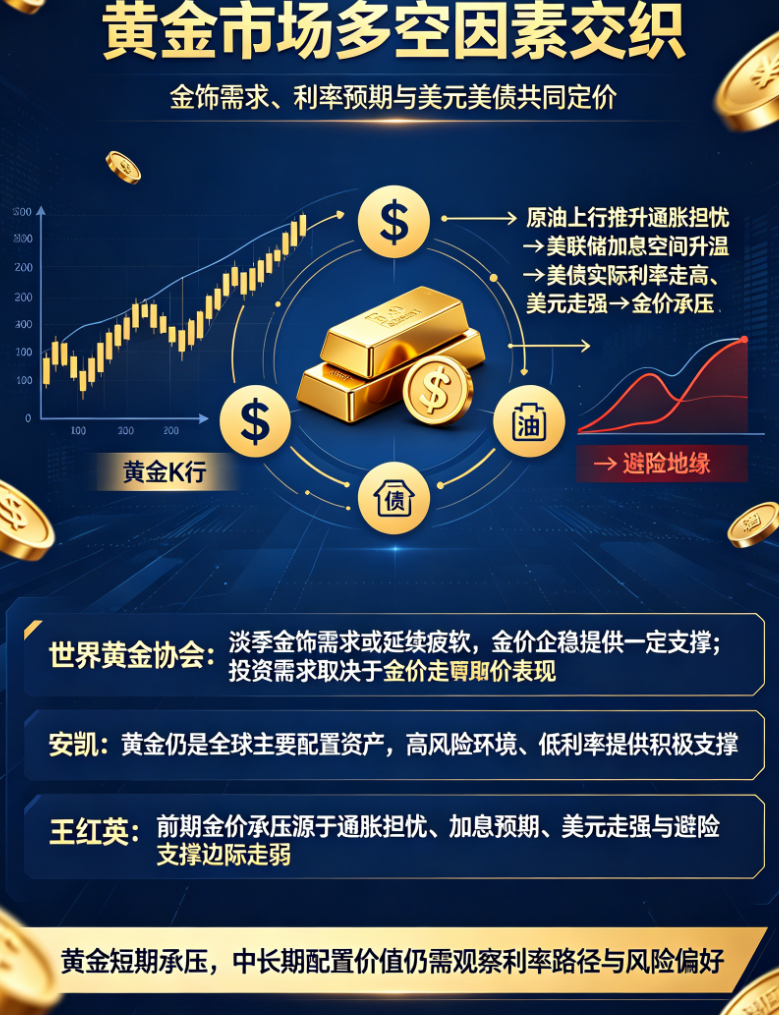
In-depth analysis of gold market outlook: the battle between weak jewelry demand and investment demand. Drawing on World Gold Council insights, it interprets impact of gold price, Fed policy, US Treasury yields, and geopolitics on the gold market.
Gold Market Outlook: Multiple Battles Between Weak Jewelry Demand and Investment Demand
Keywords
Gold market, jewelry demand, investment demand, gold price trend, Fed policy, US Treasury yield, inflation expectation, geopolitics
Introduction
Currently, the global gold market is at a critical and complex stage. As a special asset with both commodity and financial attributes, gold's price trend is deeply influenced by multiple factors. The latest analysis from the World Gold Council indicates that during the traditional off-season for gold jewelry consumption, jewelry demand is expected to remain weak, but a stable gold price will provide some support. Meanwhile, investment demand will still depend on gold price trends and domestic stock market performance. This judgment reveals the structural contradiction facing the gold market: weak consumption is hard to change, while investment is highly dependent on macro environment changes. To deeply analyze the future direction of the gold market, this article will combine industry authoritative views and macro background to conduct a systematic analysis.
1. Jewelry Demand: Off-Season Effect and Structural Challenges
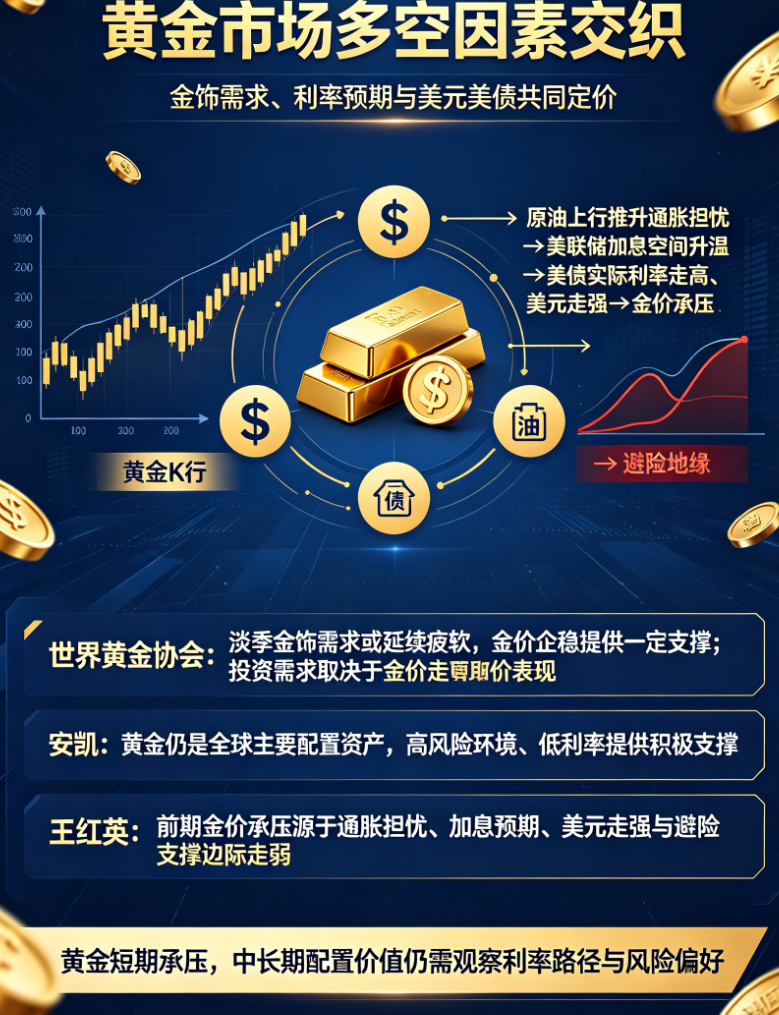
As an important component of gold consumption, the jewelry market's demand changes directly reflect fluctuations in residents' consumption capacity and willingness. The reference content clearly states that the World Gold Council expects demand to continue its weak trend during the traditional off-season for gold jewelry consumption. This judgment is not accidental.
From a seasonal perspective, the traditional off-season usually corresponds to the ebb of holiday consumption peaks. After peak consumption periods such as wedding season and Spring Festival, consumers' willingness to purchase gold jewelry often naturally declines. Such cyclical fluctuations have been common historically. However, the situation this year is more complex—under the high gold price environment, consumers' purchasing power is significantly suppressed. Price-sensitive consumers choose to wait and see, while necessity buyers tend to purchase smaller, simpler designs to control spending while meeting decorative needs.
Notably, the World Gold Council also emphasizes that a stable gold price will provide some support. This judgment contains dialectical logic: if gold prices stabilize within a certain range, consumers' price expectations will become clearer, and pent-up demand may gradually be released. In other words, sharp price fluctuations suppress consumption, while price stability activates demand. For jewelry enterprises, the business strategy at this stage should focus on product differentiation and channel optimization, rather than blind price cuts and promotions.
2. Investment Demand: Dual Drivers of Gold Price and Stock Market
Unlike consumption, gold investment demand has strong safe-haven and asset allocation functions. According to the reference content, the future direction of investment demand depends on gold price trends and domestic stock market performance. This judgment reveals the dual driving mechanism of gold investment.
From the perspective of gold price trends, as a non-yielding asset, gold's price changes directly determine investors' holding return expectations. When gold prices are on an upward trend, investors tend to increase holdings to capture capital gains; conversely, when prices decline under pressure, panic selling and profit-taking exacerbate volatility. However, the reference content shows that investment demand does not entirely follow gold trends—when prices stabilize, some medium-to-long-term investors may view it as a buying opportunity, forming demand-side support.
More noteworthy is the correlation between domestic stock market performance and gold investment demand. Historical experience shows that when the stock market rises and risk appetite improves, funds tend to flow to equity assets, reducing gold's appeal as a safe haven; conversely, when the stock market fluctuates or adjusts, gold's safe-haven function becomes prominent, and investment demand increases. This seesaw effect is particularly evident in the current context where the economic recovery foundation is not yet solid. Investors need to closely monitor domestic stock market liquidity conditions and policy signals to determine the best allocation window for gold investment.
3. Macro Interpretation of Gold Price Trends: Fed Policy and Geopolitical Battles
An Kai, CEO of the Americas and Global Head of Research at the World Gold Council, pointed out that despite recent gold price volatility and pullbacks, gold remains a major global allocation asset, and high-risk environments and low interest rates will provide positive support for gold price increases. This view represents mainstream industry opinion—against the backdrop of long-term macro uncertainty, gold's strategic allocation value should not be underestimated.
However, in the short term, the gold market faces significant downward pressure. Wang Hongying, Dean of the China (Hong Kong) Financial Derivatives Investment Research Institute, conducted a systematic analysis. She believes that the main reasons for gold's recent weakness focus on the following aspects:
First, earlier crude oil price increases fueled inflation concerns. As the 'blood' of industrial production, crude oil price increases directly push up production costs and consumer goods prices, triggering market fears of runaway inflation. In this scenario, the market bets that the Fed has room to raise interest rates to curb inflation momentum.
Second, rising US Treasury real yields and a stronger dollar suppressed gold prices. As the anchor of global asset pricing, rising US Treasury real yields directly increase the opportunity cost of holding gold, since gold itself generates no interest income. Meanwhile, a stronger dollar makes dollar-denominated gold assets more expensive for investors holding other currencies, dampening global gold demand.
Third, expectations changed after the drop in US core CPI in June. Data showed that the US core consumer price index fell more than expected in June. This change led to a rapid cooling of market expectations for Fed rate hikes. Theoretically, a cooling of rate hike expectations should favor a gold price rebound, but the earlier overpricing adjustment caused volatility due to expectation gaps.
Fourth, marginal support from geopolitical safe-haven demand weakened. The normalization of geopolitical conflicts has led the market to develop a certain 'immunity' to the safe-haven demand they trigger. When conflicts do not significantly escalate, gold's safe-haven premium gradually fades, and speculative positions bought earlier due to geopolitical risks face unwinding pressure.
Combining these factors, gold prices have been under sustained downward pressure over the past period, forming a pullback cycle. However, An Kai's view provides a long-term perspective: against a backdrop of accumulating macro risks, gold remains an irreplaceable allocation asset. Low interest rates, actual demand for tail-risk hedging, and continued central bank gold purchases will provide long-term support for gold prices.
4. Conclusion and Outlook
Looking ahead, the gold market will enter a new phase of intensified long-short battles. On the demand side, jewelry consumption faces challenges during the traditional off-season, but stable gold prices may stimulate some potential demand; investment demand still depends on the interaction between gold price trends and stock market performance. On the macro level, changes in Fed monetary policy, the dollar index trend, geopolitical conflicts, and crude oil price volatility will continue to influence the short-term direction of gold prices.
Overall analysis indicates that the gold market is currently at a critical turning point. In the short term, gold prices may continue to fluctuate under macro resistance; in the medium to long term, high-risk environments, low interest rate trends, and systematic support from central bank gold purchases will make gold's strategic allocation value more prominent. For market participants, rationally viewing volatility and seizing structural opportunities is the key to preserving and growing assets in a complex market environment.
In the future, investors should closely monitor the Fed's monetary policy path, the evolution of US economic data, and changes in the global geopolitical landscape. Based on analysis from the World Gold Council and industry experts, although the gold market faces periodic demand pressure and price adjustments, its asset allocation value has not diminished but will show greater resilience and flexibility in the new macro balance.
Note: The images shown in this article are for illustration purposes only. Actual data should refer to official market public data.

All information, quotes, analysis, and research reports on this website are for reference only and do not constitute any investment advice, trading recommendations, or financial solicitation. Market risk exists, invest with caution.