


International Gold Price Volatility: Position Anxiety and Trend Analysis

This article analyzes the causes of international gold price volatility around $4,000 from long-term, medium-term, and short-term dimensions, including central bank purchases, US debt pressure, and geopolitical variables, providing investors with systematic forward-looking judgment.
International Gold Price Volatility: In-depth Analysis of Position Anxiety and Future Trend
Recently, the international gold price has been oscillating around $4,000/oz, with market participants generally feeling rising position anxiety. How long will this consolidation last? Where is the downside limit? This article analyzes from long-term, medium-term, and short-term dimensions, combining global economic landscape, monetary policy direction, and geopolitical variables, providing investors with systematic analysis and forward-looking judgment.
1. Long-term Trend: Strong Bottom Support, Big Bull Market Just Waiting for a Signal
Gold, as a dollar inverse pricing asset, has its long-term bottom closely tied to the strength of the dollar's global monetary credit. Currently, central banks around the world are accelerating the diversification of foreign exchange reserves, major economies are vying for monetary discourse power, and the monetary landscape reconstruction process is irreversible. At the same time, US national debt has approached $40 trillion, with mounting debt pressure, which undoubtedly solidifies the upward foundation for gold's long-term price.
From actual data, many central banks continue to increase gold reserves, forming a long-term safety cushion for gold prices. Central banks reducing US Treasuries and diversifying foreign exchange risks have become a national-level long-term strategy, unaffected by short-term gold price fluctuations. Every deep correction in gold prices ushers in a window for central banks to accumulate at lows, effectively locking in the long-term downside. Therefore, the general direction of international gold prices will not change due to short-term fluctuations.
However, many investors easily fall into a key misconception: Long-term uptrend does not equal immediate bull market. The real trigger for a new gold bull market is the official entry of the Federal Reserve and major global central banks into a rate-cutting cycle. Before the rate-cutting cycle materializes, all geopolitical and safe-haven sentiment boosts can only bring impulsive rebounds, not sustained one-sided bullish trends.
Specifically, before rate cuts, the ultimate resistance level for this rally is locked at $4,580/oz. If investors' average holding cost is above this level, they need sufficient patience to endure the current high-rate consolidation cycle. When the rate-cutting cycle arrives depends on three core variables: first, the overall global economic recovery; second, the cooling and resolution of large-scale geopolitical conflicts; third, major power game reaching phased cooperation consensus, or the launch of a new global financial settlement system. Unfortunately, none of these events can be predicted to a specific month, and even national macro policymakers can only adjust policies dynamically based on monthly economic data, with no fixed timetable.
2. Medium-term Trend (Before December 2026): Volatility Continues to Narrow, Trading Range Set at $3,650~$4,580/oz
From a medium-term perspective, core observation variables focus on the actual implementation of global monetary policies around December 2026, the evolution path of the Russia-Ukraine situation, and the direction of the US-Iran geopolitical conflict. From a game theory perspective, all parties have no intention of quickly ending the conflict, contradictions will intertwine over a long period, geopolitical sentiment will fluctuate, and will not be cleared all at once.
This pattern translates to the monetary policy level, manifested as a dilemma for central banks: the current global economy cannot bear the economic slowdown pressure from continued rate hikes, nor can it immediately cut rates to prevent inflation from rebounding. Ultimately, the optimal choice for central banks is verbal intervention on expectations while actually adopting small rate adjustments. Under this background, neither extreme loose nor extreme tight scenarios will occur.
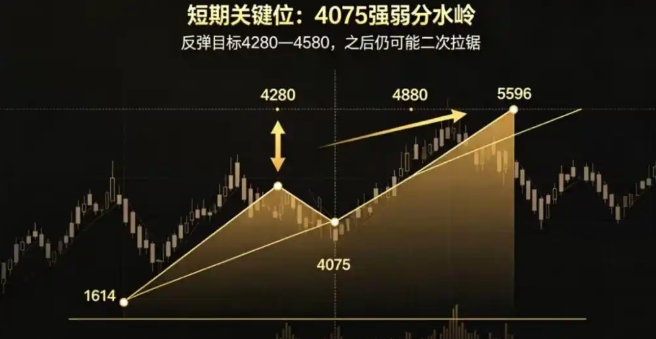
The direct result of the monetary policy stalemate is the continued decline in volatility for precious metals such as gold and silver. Looking back at the first half of 2026, international gold prices fluctuated over $100 daily; after entering the consolidation cycle, the normal daily range has narrowed to $40~$60, only briefly spiking to $100 driven by extreme news events. It is expected that the $40~$60 daily range will become the new normal in the medium term. This narrow-range volatility will significantly benefit quantitative and algorithmic trading, while the difficulty of subjective manual trading will increase substantially.
Regarding the medium-term trading range, the comprehensive judgment is $3,650~$4,580/oz. The lower bound is anchored by central bank purchase costs and long-term support lines, while the upper bound corresponds to the resistance level before rate-cut expectations are realized. Investors should avoid chasing highs and selling lows at the extremes of the range, and instead adopt a strategy of buying on dips and selling on rallies in the oscillating market.
Special attention should be paid to silver's medium-term trend. Silver's previous support came half from financial safe-haven reserve attributes and half from photovoltaic industrial demand. However, base metals like copper can now be widely substituted for silver in photovoltaic applications, directly cutting off silver's most important industrial demand support. Additionally, silver currently cannot replicate gold's global central bank reserve allocation logic, and its financial attribute is relatively weak. Therefore, the medium-term upside elasticity of silver is much weaker than gold, while downside risk is greater. Investors should not subjectively believe that a price halving is the absolute bottom—silver's historical long-term bottom has been below $49/oz for a long time, and the bottoming process will be very lengthy.
3. Short-term Trend: $4,075/oz as the Bull-Bear Divide, First Rebound then Second Tug-of-War
In the short term, the market faces two core variables: one is the sudden US-Iran geopolitical disruption, and the other is the December Fed rate hike/cut probability expectations. The direction of geopolitical conflicts cannot be accurately predicted, and ordinary traders should not chase highs and sell lows based on geopolitical news. Geopolitical factors only bring short-term impulsive fluctuations and cannot change the original consolidation structure. Oil price fluctuations can indirectly drive short-term sharp volatility in gold, but with short persistence.
Fed rate expectations are the dominant factor in short-term movements. Currently, the probability of a rate hike or maintaining high rates is between 60% and 80%, which is short-term bearish for gold, with bears in advantage. If the probability of a Fed rate hike expectation falls below 60%, it will be short-term bullish for gold rebound. Therefore, $4,075/oz becomes an important bull-bear divide in the short term.
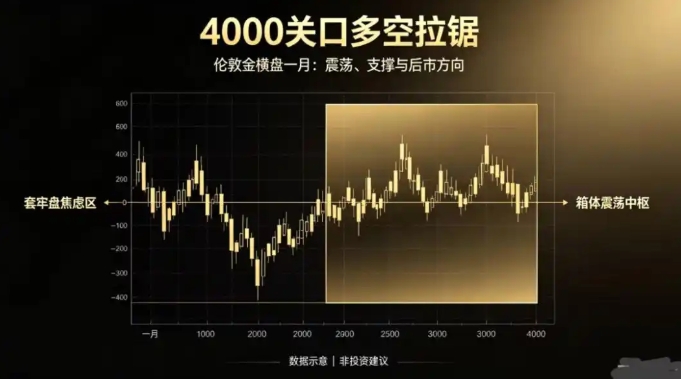
Comprehensively judging from technical and sentiment perspectives, the short-term trend is likely to present a pattern of "first rebound then second tug-of-war". That is, after a rapid decline to test support, a rebound occurs driven by bargain hunting and geopolitical pulses, but the rebound height is limited by the high-rate environment, followed by another decline and consolidation. Investors should closely monitor changes in market expectations before and after each Fed meeting, as well as unexpected escalations in the Middle East.
Conclusions and Strategy Suggestions
Combining the analysis from long-term, medium-term, and short-term dimensions, the following core conclusions can be drawn:
First, in the long term, central bank purchases and dollar credit weakening provide a solid bottom for gold prices, but the start of a big bull market must wait for the signal of a rate-cutting cycle. Before that, $4,580/oz is a difficult-to-break resistance level.
Second, in the medium term until the end of 2026, the market will maintain a range oscillation of $3,650~$4,580/oz, with volatility continuing to narrow. Quantitative trading will dominate, and discretionary trading requires caution.
Third, in the short term, take $4,075/oz as the bull-bear divide. It is recommended that investors accumulate positions near the lower bound of the range and reduce positions to wait near the upper bound, avoiding chasing highs.
For investors with holding costs above $4,580/oz, sufficient patience and holding confidence are needed to exchange time for space and wait for the rate-cutting cycle. For those with light or no positions, now is a good opportunity to use the oscillation range for buying low and selling high, accumulating low-level chips. The core logic of gold investment always lies in a deep understanding of monetary credit and macro cycles, not in chasing short-term spreads. Only by maintaining rationality and discipline can one stand firm in the ever-changing market.

All information, quotes, analysis, and research reports on this website are for reference only and do not constitute any investment advice, trading recommendations, or financial solicitation. Market risk exists, invest with caution.