


Gold Correction: Opportunities & Outlook – Institutions Bullish on Long-Term Uptrend
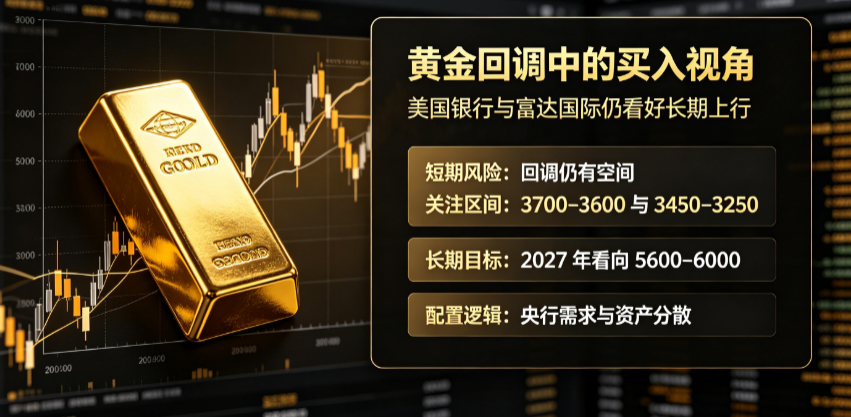
Recent gold price correction has drawn attention, but institutions like Bank of America remain long-term bullish, viewing the correction as a buying opportunity. As a safe haven, gold retains investment value amid uncertainty.
Opportunities and Outlook Amid Gold Price Correction: Institutions Bullish on Long-Term Uptrend
Keywords
Gold price, buy on correction, investment strategy, institutional view, 2027 forecast, central bank demand
Body
Recently, the international gold market has experienced a significant correction, sparking widespread attention and discussion among investors about the precious metal's trajectory. Amid ongoing global economic uncertainty and persistent geopolitical risks, the price volatility of gold as a traditional safe-haven asset naturally affects many investors. Despite short-term pressure, multiple well-known international financial institutions remain firmly bullish on gold in the long run, believing that the current correction offers a rare entry opportunity for investors.
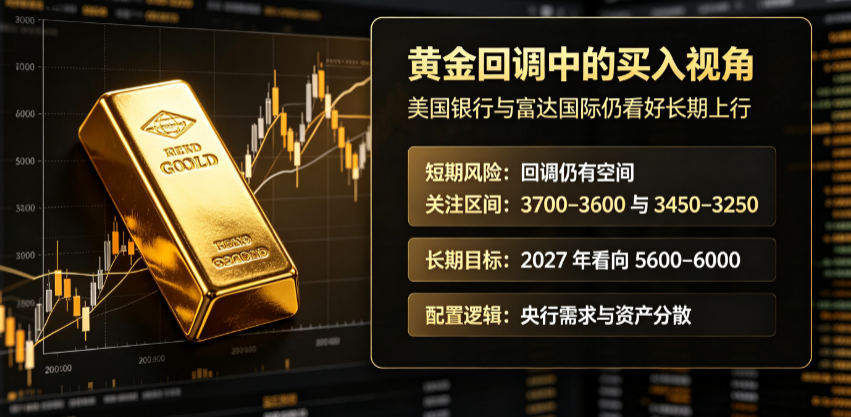
Institutional Stance: Correction Is Not a Trend Reversal, Long-Term Bullish Thesis Unchanged
Bank of America has not abandoned its bullish view on international gold prices due to short-term market fluctuations. In its latest research report, the bank's analysts clearly state that although the current correction may not yet be over and could even see further declines, from a strategic asset allocation perspective, the drop in gold prices is an excellent opportunity to buy on weakness. This view reflects the institution's high recognition of gold's long-term value and a rational attitude toward short-term market noise.
Bank of America analyst Paul Chiana elaborated further. He expects that the current gold price correction will take more time to digest previous gains and release market sentiment. From a technical analysis perspective, Chiana believes gold prices may eventually test support around $3,600 per ounce, and only after reaching this key level will the market likely find a more solid bottom. This judgment is based on a comprehensive consideration of historical price trends, market sentiment indicators, and capital flows.
Chiana further emphasized that lower prices will provide investors with highly attractive buying opportunities. In his view, gold prices below $4,000 per ounce are already worth serious consideration. Given the remaining downside risk, he prefers to position within the $3,700 to $3,600 range, and even look toward deeper support zones of $3,450 to $3,250. This layered entry strategy reflects the wisdom of professional investors in managing risk and capturing opportunities amid market volatility.
Gold Mining: One of the Most Profitable Sectors in the Market
Notably, Bank of America has not limited itself to simple price forecasts, but examines gold's investment appeal from a broader industry chain perspective. The bank's equity analysts point out that gold mining has become one of the most profitable sectors in the current market. This assessment is based on in-depth analysis of key metrics from major global gold mining companies, including production costs, output growth, cash flow, and shareholder returns.
Against a backdrop of persistent inflationary pressure and heightened currency depreciation risk, gold mining companies have demonstrated strong profitability thanks to their unique business model. Their direct link to gold price fluctuations allows these companies to achieve excess profit growth during price uptrends. At the same time, gold miners have generally strengthened cost control and improved operational efficiency in recent years, maintaining relatively healthy profit margins even in a correction environment.
Long-Term Target: $6,000 per Ounce Vision for 2027
Bank of America holds an extremely optimistic view of gold's long-term prospects. The bank maintains that international gold prices could reach $6,000 per ounce by 2027. This ambitious target is not baseless, but stems from in-depth analysis of multiple factors, including the global economic landscape, monetary policy direction, and gold supply-demand fundamentals.
At the macro level, the accommodative monetary policy stance of major central banks is unlikely to reverse fundamentally in the near term, with real interest rates remaining low or even negative for an extended period, creating a highly favorable pricing environment for gold as a non-yielding asset. Meanwhile, persistent geopolitical risks, rising global debt levels, and challenges to major fiat currency credit systems further strengthen gold's appeal as a store of value.
On the supply-demand side, growth potential for global gold mine output is limited, new mine development cycles are long, while central bank gold purchases continue to rise and investment demand recovers, together building a solid demand base for the gold market. This change in supply-demand dynamics provides strong fundamental support for long-term gold price appreciation.
Echoes from Peers: Fidelity International's Bullish Logic
Bank of America's view is not isolated. Ian Samson, multi-asset portfolio manager at Fidelity International, also expresses a firm bullish stance on gold's future. He believes that the key factors driving international gold prices to $5,600 per ounce remain intact, including continued central bank gold buying, safe-haven demand from geopolitical uncertainty, and growing investor demand for inflation hedging tools.
Samson explicitly states that international gold prices are expected to re-enter a bull market by 2027. This judgment has shifted his investment allocation strategy from wait-and-see to actively bullish, viewing gold as a preferred asset class over others. In his view, gold offers unique risk-return characteristics in the current uncertain investment environment, providing effective diversification and hedging protection for portfolios.
Regarding specific timing, Samson says he plans to increase gold holdings again; the question is when to act. From a tactical perspective, he recognizes that gold prices currently face both headwinds and tailwinds. On one hand, the dollar's strength, market risk appetite, and technical factors may put short-term pressure; on the other hand, inflation expectations, central bank policies, and geopolitical risks provide support. This interplay of opposing forces makes short-term price direction uncertain.
Samson expects gold prices to be slightly higher than current levels by year-end. This implies that prices may remain range-bound in the near term, without a sharp unilateral rally. However, over a longer time horizon, he believes gold will re-enter a bull market by sometime in 2027. Throughout this process, central bank demand for gold will be the most important structural force supporting international gold prices in the medium to long term.
Central Bank Gold Buying: Core Support for Gold Prices
In-depth analysis shows that continued central bank gold purchasing is indeed one of the most critical factors supporting long-term gold price appreciation. In recent years, central banks of emerging market countries such as China, India, and Russia, as well as some developed countries, have increased their gold reserve allocations. This trend reflects declining trust in the dollar-dominated international monetary system and a pursuit of diversified reserve structures.
Central bank gold buying not only directly increases real demand for gold, but more importantly, sends a strong signal to the market: gold, as a hard asset free from sovereign risk and unaffected by any single country's monetary policy, is gaining status in international reserve systems. This signaling effect often triggers follow-up buying by other institutional and individual investors, further boosting gold demand.
Historically, central bank gold purchases are typically long-term, stable, and counter-cyclical. Even during global economic recovery and rising risk appetite, central banks rarely sell off gold reserves on a large scale. This stable demand base provides a solid floor for gold prices.
Investment Strategy Suggestions and Risk Warnings
For ordinary investors, the current correction in the gold market undoubtedly offers an investment opportunity worth attention. However, before making investment decisions, one must fully recognize the risks and challenges involved in gold investment.
First, short-term volatility in gold prices cannot be ignored. Unexpected adjustments in Federal Reserve monetary policy, surprisingly strong economic data, or temporary easing of geopolitical tensions can all trigger sharp price swings. Therefore, investors need sufficient risk tolerance and patience for long-term holding.
Second, from an asset allocation perspective, the proportion of gold in a portfolio should be arranged according to individual risk preference and investment goals. Generally, it is recommended to keep gold allocation between 5% and 15% of the portfolio, balancing hedging benefits without excessively affecting overall returns.
Finally, investors need to consider the specific channels for gold investment. Whether physical gold, gold ETFs, gold mining stocks, or gold futures and options, each instrument has unique risk-return characteristics and applicable scenarios. Investors should choose the method that best suits their investment experience, capital size, and risk tolerance.
Conclusion
In summary, although international gold prices face short-term correction pressure, from a long-term perspective, multiple well-known international institutions remain firmly bullish on gold's prospects. The core logic is that continued growth in central bank gold demand, a prolonged low real interest rate environment, geopolitical risks, and improved profitability of gold mining companies all provide solid fundamental support for long-term price appreciation.
For investors, the current market correction may indeed be a strategic window worth serious consideration. As Bank of America analysts say, lower prices will offer buying opportunities. With a full understanding of risks, proper risk management, and asset allocation, moderate participation in gold investment may contribute steady long-term returns to a portfolio. After all, in an uncertain world, gold as a cross-cycle store of value still holds long-term investment value worth anticipating.

All information, quotes, analysis, and research reports on this website are for reference only and do not constitute any investment advice, trading recommendations, or financial solicitation. Market risk exists, invest with caution.