


Fed Holds Steady as Precious Metals Come Under Pressure
The Fed has paused rate hikes again and sent mildly hawkish signals, while geopolitical risks have eased, causing precious metals futures such as gold and silver to come under pressure and retreat. This article examines how interest rate expectations, safe-haven demand, and dollar trends affect gold and silver prices.
Fed Keeps Rates Unchanged as Geopolitical Risks Ease, Pressuring Precious Metals Lower
Keywords: Gold, Silver, Federal Reserve, precious metals futures, safe-haven demand, geopolitics, dollar trend, market expectations
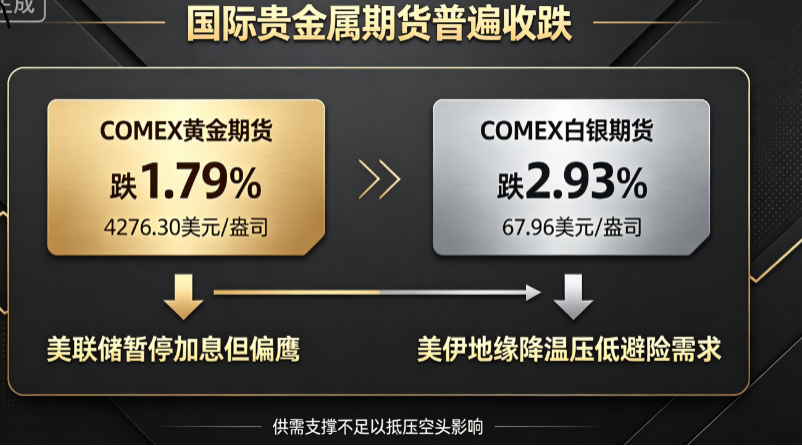
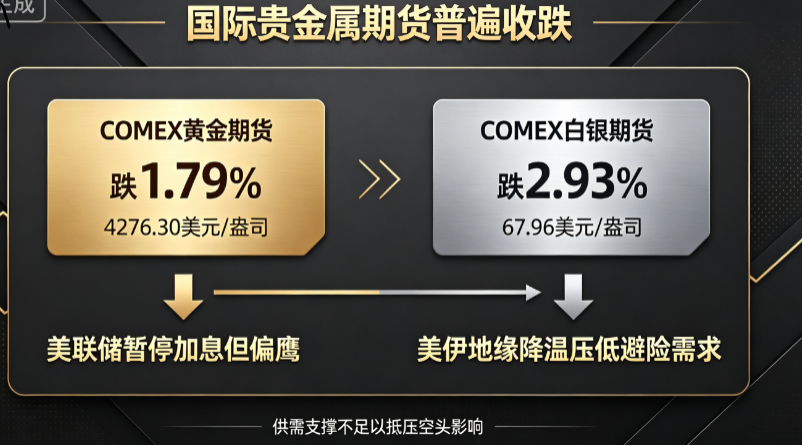
On June 17, the international precious metals futures market weakened broadly. COMEX gold futures fell 1.79%, to $4,276.30 per ounce; COMEX silver futures dropped even more, down 2.93% to $67.96 per ounce. After a relatively strong run-up, precious metals have recently given back notable gains, reflecting simultaneous shifts in market sentiment, interest rate expectations, and the safe-haven narrative.
On the surface, the declines in gold and silver are mainly price corrections, but on a deeper level, this pullback is driven not by a single factor, but by the combined effect of macro policy, geopolitical developments, and market technicals. In particular, after the Federal Reserve paused rate hikes for the fourth consecutive time, the policy rate remained unchanged as expected, but the neutral-to-hawkish signals it sent cooled investors' optimistic expectations for rate cuts this year, putting pressure on precious metals.
1. Hawkish policy signals are weighing on precious metals valuations
In general, gold does not yield interest, so its price is highly correlated with real interest rates. When the market expects rates to fall and liquidity to loosen, gold's allocation value rises accordingly; conversely, if policy turns cautious or even hawkish, the opportunity cost of holding gold increases and gold prices often come under pressure.
This time, although the Fed pressed pause again, it did not release a clear easing signal. Instead, it reinforced a stance of data dependence and the need to keep watching inflation. That means the market's earlier expectation of a rapid rate-cut cycle needs to be recalibrated. For gold, this shift is especially important, because one of the core reasons supporting its elevated prices has been the early pricing of a looser monetary environment.
Silver's volatility is usually greater than gold's, partly because it has both financial and industrial attributes, and partly because its market size is relatively smaller. In an environment of declining risk appetite and a broad cooling in precious metals, silver often amplifies gold's pullback, which is why its decline was more pronounced this time.
2. Easing geopolitical tensions have temporarily reduced safe-haven buying
Beyond monetary policy, geopolitical factors have also been a major driver of precious metals prices recently. Earlier, the escalation of tensions in the Middle East significantly lifted market risk aversion, and gold, as a traditional safe-haven asset, was heavily bought. However, as geopolitical risks between the U.S. and Iran eased for the time being, concerns about sudden conflict diminished, safe-haven funds began to flow out, and precious metals lost part of their sentiment support.
Historically, geopolitical risks tend to affect gold prices in a pulse-like way: when events escalate, gold rises quickly; once tensions ease, the related premium tends to be given back relatively fast. This pullback reflects that pattern. In other words, gold's earlier rise was not entirely built on sustained improvement in long-term fundamentals; part of the gains came more from short-term safe-haven demand, so once risks eased, prices naturally faced correction pressure.
3. Supply-demand fundamentals still offer support, but not enough to offset bearish forces
That said, precious metals have not completely lost fundamental support. Gold still has strong medium- to long-term value, supported by global central bank gold buying, financial uncertainty, and demand for long-term asset allocation. Silver also benefits from growing industrial demand in new energy and electronics manufacturing, and its long-term demand outlook is not pessimistic.
But at this stage, support from the supply-demand side is more of a floor protection and is not enough to directly reverse the short-term bearish structure. The reason is that the stage-by-stage movement of precious metals prices is usually first driven by macro expectations rather than pure spot supply and demand. In particular, when the Fed's policy expectations turn cautious and the dollar and real yields remain resilient, gold and silver may still have fundamental support but will struggle to form a one-way uptrend in the short term.
In addition, the market's sensitivity to bullish news often declines in high-price zones, while its reaction to negative factors becomes faster and stronger. In other words, when gold has already risen to a high range, any hawkish policy tone, easing of risks, or profit-taking can quickly magnify the size of the correction. This is another key reason why gold and silver weakened together this time.
4. Short-term trend may enter high-level consolidation
From a technical perspective, precious metals had accumulated a large amount of unrealized gains after their earlier rally, and increased profit-taking at elevated levels was one of the important drivers of the recent correction. Gold has now pulled back to around $4,276 per ounce from its highs; if there is no new macro catalyst, the market will likely enter a period of range-bound consolidation at elevated levels. Silver, with greater volatility, may face a more obvious retracement and faster turnover.
For investors, it is not advisable to judge a trend reversal based solely on a single day's decline. A more reasonable framework should include the following: first, whether subsequent economic and inflation data from the Fed support expectations for rate cuts; second, whether tensions in the Middle East re-escalate and lift safe-haven demand again; third, whether the dollar index and U.S. Treasury yields show a directional change; and fourth, whether physical demand and central bank gold buying remain strong.
If the above variables do not show a significant turn, the precious metals market is more likely to exhibit elevated-level wide swings rather than immediately enter a trend-like down move. For medium- to long-term allocation capital, gold's asset characteristics have not changed; but for short-term traders, greater volatility and deeper pullbacks mean position management and risk control need even more attention.
Conclusion
Overall, the broad decline in international precious metals futures on June 17 was the result of the combined effect of macro policy expectations, easing geopolitical risks, and short-term profit-taking by funds. The Fed's neutral-to-hawkish stance weakened the market's confidence in a rapid easing cycle; easing U.S.-Iran tensions caused safe-haven demand to fade temporarily. In this context, although gold and silver still have some medium- to long-term support, it is not enough to offset short-term bearish pressure.
Looking ahead, the core drivers of precious metals remain the rate path and risk appetite. As long as policy expectations do not loosen materially and safe-haven sentiment does not reheat, gold and silver prices may continue to digest gains around elevated levels. For market participants, the focus should be on the logic behind the trend, not just on the prices moving up and down.

All information, quotes, analysis, and research reports on this website are for reference only and do not constitute any investment advice, trading recommendations, or financial solicitation. Market risk exists, invest with caution.